An Unusual Diagnosis
by Jennifer Hill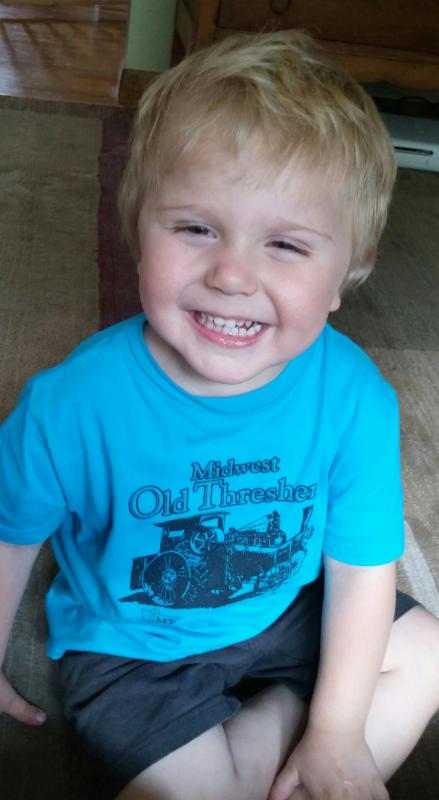
Carter was born healthy and without complications. He was our first child, and other than a mild case of jaundice, we had no indication in those first couple of weeks that anything was wrong. Around one month of age, Carter developed a few concerning symptoms; a grossly distended abdomen, faster than normal respiratory rate, and stridor with eating. Our pediatrician originally diagnosed Carter with pneumonia, but treatment for the pneumonia failed and we were referred to a pulmonologist. The pulmonologist diagnosed Carter with laryngomalacia, an essentially benign condition where the larynx is floppy. The problem then became that laryngomalacia did not explain the rapid respiratory rate or abdominal distension. The next step was a referral to gastroenterology.
X-rays of Carter's abdomen showed his distention was due to large amounts of intestinal gas. The GI doctor suspected Hirshsprung's, but Carter's rectal biopsies were negative. After much discussion, we made the decision to forgo further testing. The doctor felt the most likely explanation for Carter's bloating was air-swallowing, and that testing would be fruitless and present more risk than benefit. His fast breathing could be explained by his bloated belly limiting movement of his diaphragm. Carter had colic, but was otherwise growing and meeting milestones on schedule. It made sense to wait and see if his abdominal distension went away without intervention.
Carter continued to thrive and his colic resolved, but his abdominal distention did not. As he grew from infant to toddler, his frame thinned and his belly expanded. We again began asking Carter's pediatrician for possible causes, and went through several diet adjustments to see if food intolerance was to blame. Around 20 months of age, I noticed Carter's liver was enlarged. I skipped the pediatrician, and called to schedule an appointment with the gastroenterologist he had seen as an infant.
The GI doctor confirmed my finding and also discovered Carter's spleen was enlarged. We were scheduled for an ultrasound and sent home to wait an excruciating two days. I am a nurse by profession, and I spent many hours before his ultrasound researching possible causes of hepatosplenomegaly; I knew there would not be a benign explanation this time. The ultrasound found a seven centimeter choledochal cyst, or a cyst of his common bile duct. The chance of this finding in a Caucasian male is incredibly small, and we were all shocked (physicians included). At the time, it was believed that the cyst was to blame for his hepatosplenomegaly, which meant surgery to remove the cyst needed to be done as soon as possible. Carter was scheduled four days later for what was supposed to be a four hour surgery.
Carter's surgeon performed a laparoscopic Roux-en-Y hepaticojejunostomy, liver biopsy, and small inguinal hernia repair. The surgery took nine hours instead of four due to a significant amount of scar tissue surrounding Carter's bile duct making the surgery difficult. Instead of recovering in PACU and moving to the surgical floor, Carter had to remain on the ventilator and recover in PICU. His surgeon and GI doctor met with us post-operatively to explain that the appearance of Carter's liver did not make sense; that his white and fibrotic liver could not be explained by bile congestion from the cyst. They were preparing us for a second diagnosis.
Carter was taken off the ventilator the next morning and spent the remainder of the day in a semi-sedated, confused, and painful state. That afternoon we received his biopsy results and his diagnosis of congenital hepatic fibrosis. They did an ultrasound to evaluate his kidneys and found his to be completely normal. However, the significance of the diagnosis did not have time to sink in. That evening Carter began running a fever and his belly started increasing in size. The second post-op day Carter's condition continued to deteriorate. He developed shivers as his fever climbed and his belly rounded. We were unable to hold him for more than a few minutes because our body heat made his temperature spike. Those two days were the most heartbreaking days of my life, watching my child suffer. The need to hold him, comfort him, and relieve him of his pain created an intense physical ache. That evening, Carter's symptoms reached the severity where something had to be done. His belly was firm and hot to the touch and his shivers were bordering on convulsions. Shortly before midnight, the surgeons rushed Carter to OR for an exploratory laparotomy.
The surgeon found no infection, which was a tremendous blessing. Instead, he found that a piece of Carter's bowel had been twisted and noted that his abdomen was filled with clear, serous fluid. They performed a revision of the first surgery, placed a drain, and Carter returned to PICU on the ventilator. This time, Carter's recovery was not as straight-forward and everyone on his care team seemed on edge. Carter's total time in OR added up to over 12 hours, and it had taken a toll on his lungs. He remained on the ventilator for another day and a half while the respiratory therapists worked to get his lungs strong enough to extubate.
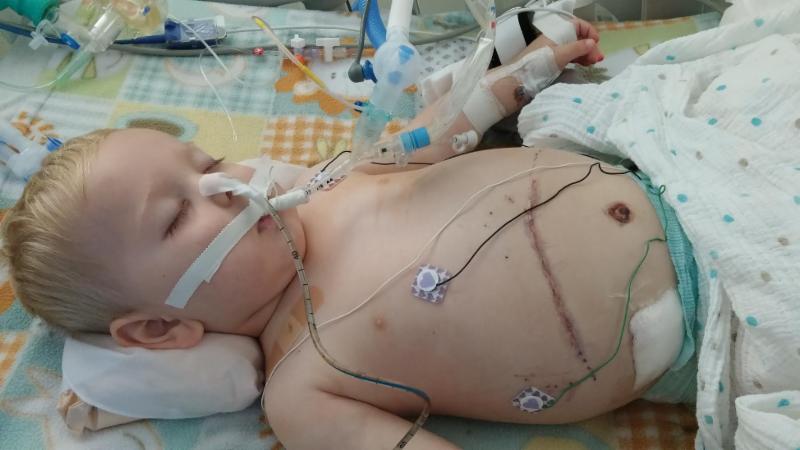 On his second post-op day of the second surgery, Carter was taken off the ventilator again. The surgeries, time under sedation, and lack of nutrition had taken an enormous toll on Carter's little body. He barely moved, and when he did, his body shook with the effort. He couldn't walk. The doctors started him on IV nutrition and ordered physical therapy. Slowly, Carter started to recover. It was a one-step forward two-steps back sort of recovery. Carter continued to run fevers, but the over-all trend was going down. He was swollen, his potassium reached a critical low, he pulled his NG tube out, his pain was difficult to control, and so on. His abdominal drain output was high, which was a confusing concern; it required testing and brought about the discussion of a possible third surgery. In the end, they determined that the high fluid output was related to Carter's congenital hepatic fibrosis. Essentially, his liver status made his vessels and tissues susceptible to fluid loss. The drain in his belly acted as a siphon, pulling fluid in to his abdominal cavity and out the drain. His doctors gave him IV albumin to reduce the shift of fluid and removed his drain to eliminate the siphon effect. It worked, and he continued to improve.
The amount of support we received during his hospitalization was overwhelming. The messages of love, gifts of food, and a Gofundme page created on Carter's behalf helped my husband and I get though with our sanity intact. It's my nature to not want to be a bother, but under these circumstances, there was no doing it alone. My daughter was two months old at the time and I was on maternity leave. Our resources, both emotionally and financially, were limited. I remember a good friend saying, "It's a lesson in gratitude, isn't it?" It truly was, and I was incredibly grateful.
After ten days in the hospital, with a little bit of pleading from me, the doctors released Carter home. He still couldn't walk very well and had half the appetite he did on admission, but his labs and vital signs were stable. A year later, the incision that extends across three-quarters of his belly has healed to a thin white scar. I've spent dozens of hours reading and researching congenital hepatic fibrosis. Carter sees a hepatologist every three months and is monitored annually with ultrasound and endoscopy. His liver and spleen enlargement improved after surgery, and his first endoscopy found no varices. Ironically, his original symptom of intestinal bloating continues to be an issue that no one can explain with any certainty.
Carter has a rare presentation of a rare disease, which means many of my questions about his future remain unanswered. What I do know is that his situation could be worse. We are fortunate that he is home; that his disease progression is slow and that he is a vibrant, cheerful three-year-old.